Skepticism: From Antiquity to the Present by Diego Machuca Baron Reed
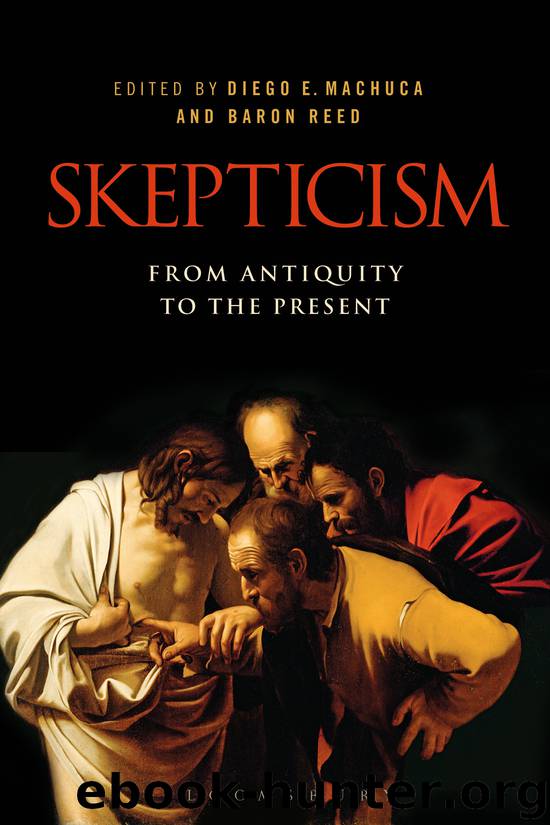
Author:Diego Machuca,Baron Reed
Language: eng
Format: epub
Publisher: Bloomsbury UK
CHAPTER TWENTY-SIX
Berkeley and Skepticism
Margaret Atherton
1 Introduction
Getting a handle on the role of skepticism in the thought of George Berkeley (1685–1753) is surprisingly difficult. As is well known, Berkeley’s case for idealism includes old and familiar skeptical arguments. And since the conclusions Berkeley wants to reach themselves seem so incredible, it is sometimes thought that an important motive for Berkeley must be to show that his central theses don’t lead to skepticism. Finally, Berkeley himself presents skepticism neither as a tool nor as a potential menace to his theory but as a target. He claims we have been led into skepticism by the views of others. The task he sets himself is to dispel the pernicious skepticism these others have encouraged. Part of the difficulty in pinning down skepticism’s role for Berkeley is also that there are too many skeptical beliefs that might be the focus of his interest in skepticism. Skepticism might be expressed in the belief that there is neither heat nor cold in the water, or that we are unable to have perceptual knowledge of ordinary physical objects, or that we are unable to know the inward essences of things.1 While any or all of these beliefs might be implicated in Berkeley’s attack on skepticism, it is important to straighten out the nature of the skepticism Berkeley takes himself to be primarily concerned with. A stress on different aspects of skepticism—ordinary objects as opposed to inward essences, for example—results in different accounts of Berkeley’s overall project. My goal here is to achieve greater clarity on this issue by answering three questions: (1) What are the skeptical beliefs Berkeley wants to dispel? (2) What are the false principles that he takes to lead to these skeptical beliefs? And (3) what is Berkeley’s goal in ridding us of this skepticism? In particular, is he seeking to return us to common sense or a version of it, or is he trying to instill a better theory based on principles that do not lead to skepticism?2
A hurdle anyone must face is that Berkeley wrote two books laying out his immaterialism, books that do not follow exactly the same line of argument. Three Dialogues between Hylas and Philonous is conspicuously structured around the issue of skepticism. The two characters agree to debate the question, who is the greater skeptic, and they return frequently to examine the implications of what they have been saying concerning the matter of skepticism. In Principles of Human Knowledge, on the other hand, Berkeley lays out his positive doctrine (PHK: 1–33)3 without any mention of skepticism at all, and when he enlarges on this doctrine in his replies to objections (PHK: 34–85), he talks about skepticism only once.4 It is natural that commentators looking to examine Berkeley’s position with respect to skepticism have focused on the presentation in Three Dialogues.5 There is nevertheless good reason to take skepticism to be equally important to the argument of the Principles. Just as he does in Three Dialogues, Berkeley signals in the full title that skepticism is a central concern.
Download
This site does not store any files on its server. We only index and link to content provided by other sites. Please contact the content providers to delete copyright contents if any and email us, we'll remove relevant links or contents immediately.
| Anthropology | Archaeology |
| Philosophy | Politics & Government |
| Social Sciences | Sociology |
| Women's Studies |
The remains of the day by Kazuo Ishiguro(8999)
Tools of Titans by Timothy Ferriss(8396)
Giovanni's Room by James Baldwin(7346)
The Black Swan by Nassim Nicholas Taleb(7129)
Inner Engineering: A Yogi's Guide to Joy by Sadhguru(6796)
The Way of Zen by Alan W. Watts(6614)
The Power of Now: A Guide to Spiritual Enlightenment by Eckhart Tolle(5782)
Asking the Right Questions: A Guide to Critical Thinking by M. Neil Browne & Stuart M. Keeley(5775)
The Six Wives Of Henry VIII (WOMEN IN HISTORY) by Fraser Antonia(5515)
Astrophysics for People in a Hurry by Neil DeGrasse Tyson(5190)
Housekeeping by Marilynne Robinson(4447)
12 Rules for Life by Jordan B. Peterson(4304)
Ikigai by Héctor García & Francesc Miralles(4274)
Double Down (Diary of a Wimpy Kid Book 11) by Jeff Kinney(4272)
The Ethical Slut by Janet W. Hardy(4253)
Skin in the Game by Nassim Nicholas Taleb(4249)
The Art of Happiness by The Dalai Lama(4130)
Skin in the Game: Hidden Asymmetries in Daily Life by Nassim Nicholas Taleb(4007)
Walking by Henry David Thoreau(3962)
